Operations Playbook · Carrier Billing & 3PLs
How to stop surprise carrier DIM weight re-bills.
Why automated carrier scan tunnels re-bill outbound cartons and pallets, what proof finance teams need to reconcile adjustments, and how to attach 3D dimensions and visual proof to every waybill in seconds.
6s
phone clip + waybill scan
97%
accuracy vs. tape measure
Photo + clip
saved per tracking number
< 24 hrs
live on existing phones
Why adjustments spike
Your WMS prints nominal box sizes. Carrier scan tunnels bill extreme outer bounds.
Every major parcel and LTL hub passes freight through high-speed overhead dimensioners. Whenever a package arrives slightly wider, taller, or more bulged than the static dimensions on your shipping manifest, an automated invoice adjustment fires days later.
1 to 2 cm of carton bulge in transit
Corrugated side walls bow slightly under stacking pressure or loose void fill. Just 1.5 cm of bulge per side on a medium carton adds 10% to 18% cubic volume and bumps the shipment into a higher DIM tier.
Popped flaps, loose tape & polybag ears
Automated carrier scan tunnels measure the extreme outer bounding box. A lifted tape edge, loose strapping loop, or unfilled polybag corner counts toward billed length, width, or height.
Silent vendor packaging changes
Suppliers swap inner cartons or outer master cases without warning. Your WMS keeps printing labels from last year's SKU master table until thousands of outbound parcels trigger adjustments.
3PL client pass-through disputes
Carrier invoice adjustments often arrive 7 to 21 days after dispatch. Without a timestamped pre-shipment photo and 3D record tied to the tracking number, 3PLs either absorb the fee or argue with merchants.
Want to check how much a 2 cm carton bulge changes your billed weight? Run your box sizes in our free DIM Weight & ROI Calculator →
Audit trail comparison
Why spreadsheet claims get denied, and what holds up.
Disputing a carrier DIM adjustment or substantiating a 3PL client pass-through comes down to whether you captured the package as it actually left your dock.
| Audit evidence element | WMS SKU catalog only | Tape measure + camera roll | Attensive 3D + waybill record |
|---|---|---|---|
| Waybill / tracking barcode link | Printed manifest row only | Hand-typed or visible if lucky | Scanned directly into the measurement record |
| Outer bounding L x W x H & DIM weight | Static nominal SKU catalog value | Single-axis tape read (misses bulge) | 3D outer bounding box + cubic volume + DIM weight |
| Visual proof of flat flaps & condition | None | 2 to 3 separate phone photos to organize | Saved photo + replayable clip attached automatically |
| UTC timestamp & station / belt ID | Label print time only | File metadata (easy to misplace) | Immutable capture timestamp, operator or belt ID |
| Warehouse labor per audited parcel | 0s (until re-bills hit finance) | 45 to 90 seconds of staging + typing | 6s on any phone, or 0s on an overhead belt camera |
Two ways to capture pre-shipment proof
Audit exceptions on any phone, or audit 100% of outbound belts on existing cameras.
Pack-out, receiving & LTL exception audits
Operators use a standard Android smartphone or rugged warehouse handheld. A 6-second video clip returns dimensions and DIM weight in seconds, pairs with the scanned barcode, and saves a photo record.
- Audit incoming vendor SKU cartons to keep WMS master dimensions clean
- Verify multi-item cartons, custom pack-outs, and outbound LTL pallets
- Works on shiny black stretch wrap, brown corrugated, and dim docks
Zero-touch 100% outbound conveyor verification
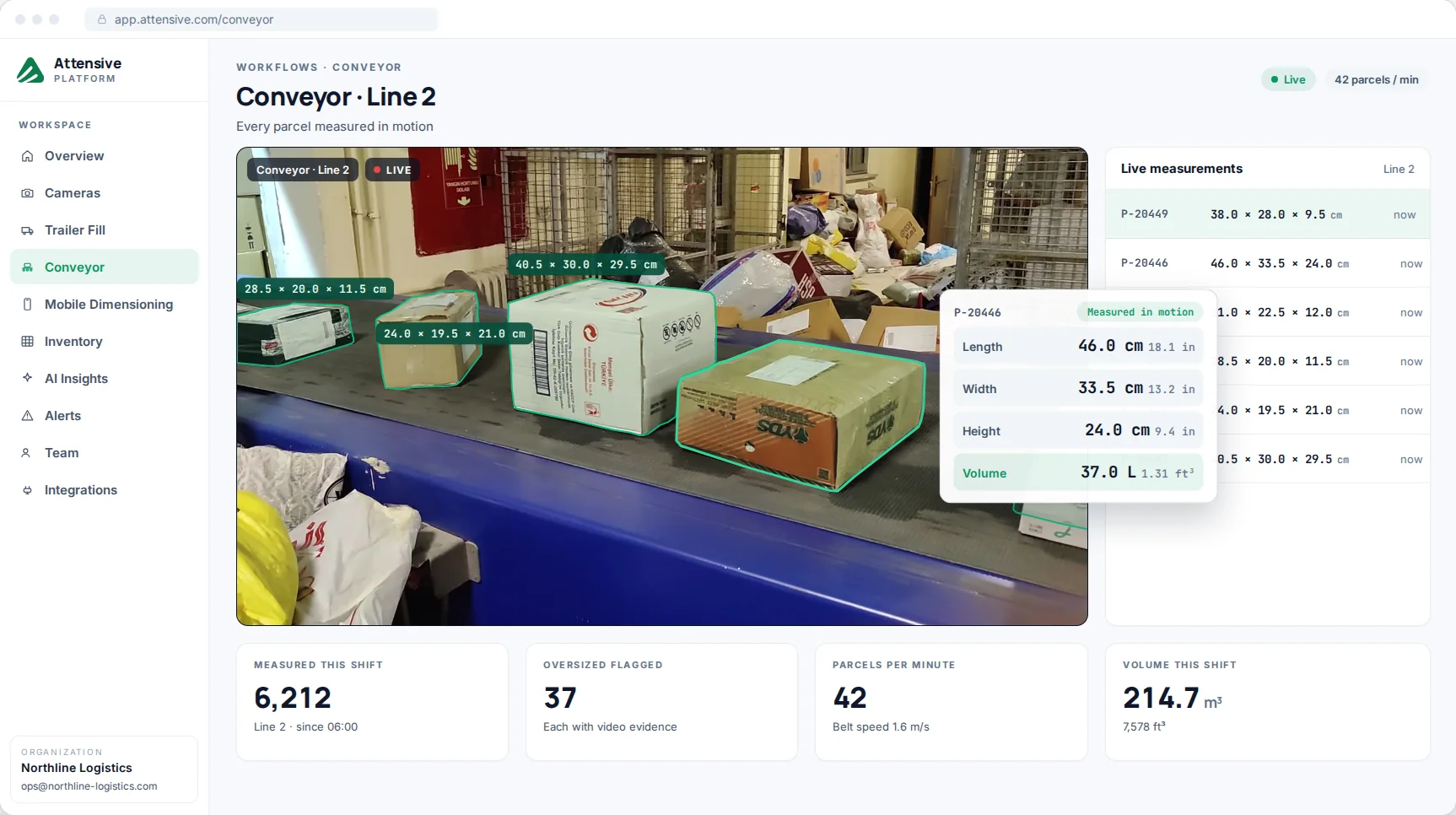
Connect the 1080p+ RTSP security cameras already watching your outbound pack lines and loading conveyors. Every carton moving past the camera gets 3D outer dimensions, cubic volume, and a timestamped video clip with zero operator steps.
- No $100k+ scan tunnel hardware, belt cutting, or sortation downtime
- Flags bulging or oversize cartons before they reach the carrier trailer
- Streams structured JSON events to your WMS, TMS, or audit database
4-step warehouse SOP
Close the gap between pack-out and carrier billing.
Flag high-leakage SKUs and oversize lanes
Start with your last 60 days of carrier invoice adjustments. Usually 15% to 20% of SKUs (large cartons, multi-item pack-outs, LTL skids, and supplier drop-ins) drive over 70% of total DIM chargebacks.
Capture waybill-linked 3D records before handoff
For pack stations, receiving, and LTL staging, operators scan the barcode and walk a 6-second phone arc ($199/device/month). For high-volume outbound conveyors, connect existing 1080p+ IP cameras (from $1,500/site/month) for zero-touch belt capture.
Sync clean master dimensions back to your WMS
Push real-world outer bounding dimensions via API, webhook, or CSV into your WMS item master so outbound carrier labels rate accurately on the very next order.
Reconcile carrier invoices with one-click visual proof
When an adjustment appears on a weekly carrier bill, match by tracking number, compare billed cube against your pre-handoff 3D measurement, and attach the timestamped photo or belt clip to your claim or 3PL client statement.
Structured audit record
Every measurement is API-ready and linked to visual proof.
Whether captured by a 6-second mobile walk-around or an overhead conveyor camera, every record pairs outer bounding dimensions and calculated DIM weight with a direct photo or clip URL.
Note on legal-for-trade invoicing: Where direct customer weight-or-cube billing requires an NTEP or OIML legal-for-trade stamp at the billing point, certified hardware remains required there. Operations and finance teams use Attensive upstream across receiving, SKU master maintenance, pack-out quality control, and photo-backed carrier invoice reconciliation.
{
  "waybill": "1Z999AA10123456784",
  "captured_at": "2026-11-26T16:08:41Z",
  "source": "mobile_app",
  "dimensions_cm": { "length": 61.2, "width": 45.4, "height": 38.1 },
  "volume_cm3": 105859,
  "dim_weight_kg_5000": 21.17,
  "quality_status": "verified",
  "photo_proof_url": "https://app.attensive.com/captures/m_4819c/photo.jpg"
}
Questions
Frequently asked
Why do parcel and LTL carriers re-bill shipments for higher dimensional weight?+
Carrier sortation hubs run automated overhead scan tunnels that measure the extreme outer bounding box of every parcel or pallet in transit. Minor carton bulge, a loose tape flap, polybag ears, pallet overhang, or outdated SKU master dimensions in your WMS can push cubic volume into a higher billing tier.
What proof helps shippers and 3PLs dispute an inaccurate carrier DIM adjustment?+
Carriers rarely accept nominal SKU master dimensions from a spreadsheet. The strongest operational evidence combines the scanned waybill or tracking number, timestamped length, width, and height captured right before dispatch, and a clear photo or video clip showing flat flaps and true package condition at handoff.
How fast can warehouse staff capture pre-shipment dimension proof on a phone?+
With Attensive Mobile, an operator records a 6-second clip of the parcel or pallet and scans the waybill barcode. Dimensions, volume, DIM weight, and a saved photo record return within seconds.
Can we automate outbound DIM audit records without scanning every box by hand?+
Yes. Attensive Facility Cameras connect to existing 1080p+ RTSP security cameras over outbound conveyors and pack-out belts, automatically recording length, width, height, cubic volume, and a timestamped video clip for parcels moving down the line.
Does Attensive replace NTEP or OIML legal-for-trade scales?+
Where direct weight-or-cube invoicing legally requires an NTEP or OIML stamp at the billing point, certified hardware is still required. Warehouses and 3PLs use Attensive alongside existing scales for pre-shipment SKU master audits, catching vendor packaging changes, oversize screening, and building photo-backed evidence for carrier invoice reconciliation.
Start capturing waybill-linked proof tomorrow.
Hop on a quick call with us, and it's running on your devices within a day. Compare it to your tape measure and decide for yourself.
Not ready for a call? Send us a message.